Pages

Showing posts with label How-To. Show all posts

Monday, April 15, 2013

Simply Healthy

Here are some of our favorite recipes, made as we used to make them - very simple, quick, and easy.   They are great for times when you are under stress or time pressures or for the beginner cook.   Most of my 5 ingredient or less recipes used to involve meat, but these are all meat-free. 


Tips for simplifying soups and stews:
  • Buy canned or frozen beans, low or no sodium
  • Use lentils as a soup base (they cook much faster)
  • Buy frozen vegetables to add to your soups
  • Buy frozen greens to add to your soups
  • Buy frozen, chopped onions & bell peppers to add to your soup.  These can be sold separately or as a cooking mix.  
  • Buy minced garlic in the jar. 
  • Use a store bought or make-your-own seasoning blend that works for all soups. Then, customizing the individual soup only takes 1 or 2 separate spices.   (See recipe below).
  • Buy pre-chopped mushrooms
  • Buy other fresh vegetables in the packaged produce section (as in, sno peas, shredded carrots, shredded broccoli slaw, and so on)
  • Buy jarred tomatoes or tubes of tomato paste. 
STOCK:
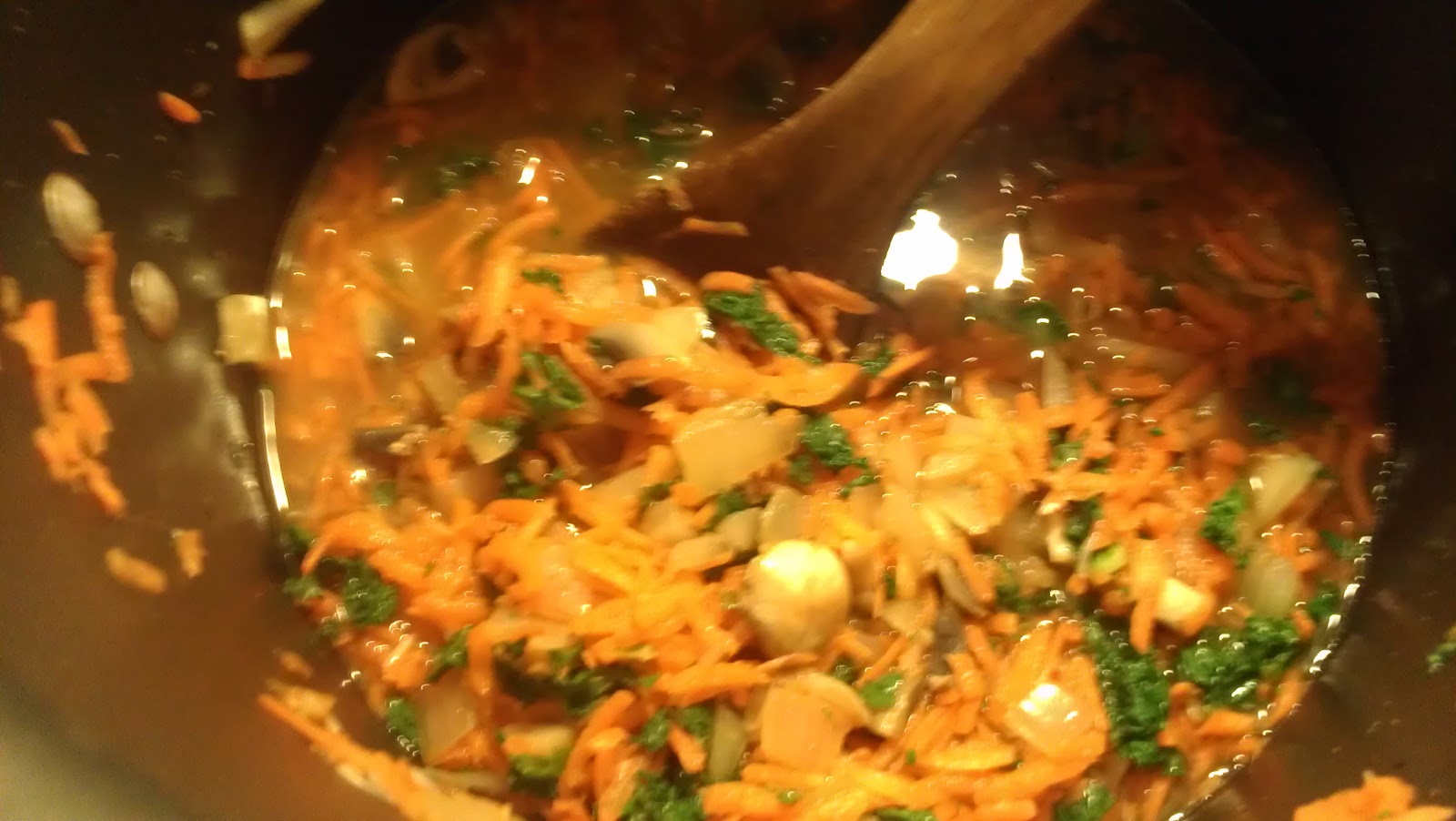
All about stock -  you can use a canned vegetable stock or a vegetable juice base like carrots, or you can make your own.   Now, this one won't be as fast as opening a can, but the taste doesn't compare either.    A very simple way to make stock is to heat a teaspoon of oil or a half cup of water in a sauté pan, then add chopped onions, bell peppers, garlic, and mushrooms to it.  Let it simmer while you gather your other soup ingredients.   You'll know it's ready by its aroma and by the onions turning translucent.   You can make it as you make the soup or make it in advance and freeze in individual portions (approximately 1-2 cups of the mix per batch of soup).    ALL of my soups start the same way – heating the onions, mushrooms, garlic and so on in a pan.   It’s a running joke around here that I get those things going in the pan even before I know what I’m cooking.   If you use canned or jarred stock or juice, you can skip the sauté step if you want and just add the ingredients in blue to the soup, but I'll say it's usually always worth taking the few minutes to sauté. 


Seasoning blends – ours has equal parts black pepper, garlic powder, onion powder, and paprika, and a 1/4th portion of cayenne and/or crushed red pepper.    Make your own, store it and save lots of time when you cook. 


Black Bean Chili, Simplified 
Really, this chili can be made from any bean you have or any combination of beans.   Many times, we've popped in the three leftover cans of navy, pinto, and black beans to scrounge up a batch of chili.  


3 Sisters Stew


Quick Lentil Soup

Split Pea and Carrot Soup

Cheezy Kale Soup


Other simple meals:
or banana bread http://plantbites.blogspot.com/2012/09/banana-bread.html

Thursday, March 14, 2013

Growing Plant Strong Kids


We all start at different places when we find Eat to Live and healthy plant based eating and our kids are all so different, but we are all aiming towards the same goal in the end so some of the same steps apply to every family.    Not all tips will apply to every family, of course.   I do not take credit for any of the ideas below but have read and learned from many various places and people who have made this work in their own lives. 


Just know that none of this is particularly easy and all of it requires dedication and extreme levels of patience on the part of all the parents involved.  I recommend keeping a list of the foods they like and continuing to offer ones they don’t, but without forcing them to eat them beyond a taste each time and without getting upset when they don’t eat them.   It can take many, many times of trying a food before they are accepted.   Sometimes it never is and that’s okay too because you can usually always find an alternative.  

First, I always start by recommending Disease Proof Your Child, even if you already have Eat to Live or other books.  There are specific recommendations for helping kids make the switch that differ greatly from the adult suggestions.   You can usually find it at your local library or order online from Amazon for around $10-15 including shipping.   Honestly, if you read and study that book, you don’t need to read further because it covers the spectrum from pregnancy to adulthood. 

The steps and tips I've collected over the years -   
 

Set the boundaries.   I read a great book years ago about healthy eating for kids and my favorite tip in it was one that Dr Fuhrman used in his book also – basically, that parents are in charge of what foods are brought into the house, and kids are in charge of what and how much they eat of what is served.   (We do not stick to that literally all of the time because now that our kids are older, 8 and 18, they are mature enough to realize that certain foods are required.  However, we do give them a choice as to how they get those foods into their body:   for greens, they can have a green/fruit smoothie, a salad, hidden in a soup, or even just plain, fresh greens eaten by themselves.   But in some way, they are required to get greens into their body that day.) 

The rule mentioned above is great for not setting up food battles/control issues early in the child’s life, and thus you can have more freedom guiding them as they get older.   At least, that has been our experience. 

A note -  It is not my goal to control my son’s food for the rest of his life, or to have him eat 100% perfectly plant based while in my home and then McDonald’s for the rest of his  adult life because his mother would never let him have a donut or ice cream.    I could easily force him to adhere to Eat to Live only foods, but I want this conversion to be his own, for him to want to eat this way, for life.    Therefore, we are taking the long view with our kids rather than forcing them and denying them any foods forever.    We don’t bring them into our home, but we do allow occasional treats outside the home.   (See the DPYC book on the subject of ice cream as a treat occasionally consumed outside the home, a perfect example of the philosophy we’ve adopted). 

Also, know how strict you need to be based on your child’s health issues, if any.   Sometimes, small children or very lean children need more than vegan foods if they do not consume foods like beans, soy, nuts in good quantities.   Parents know their kids best, so be on the watch for anything like losing weight in a lean child and so on.   At times, you may need to adjust the diet for them, as it says in DPYC and on the forums, even sometimes adding eggs and such in some cases. 

 
An Easy First Step - Build on current good habits.   Make a list of the healthy foods they already like and serve them often.   To start, I offered baby carrots, sliced cucumbers, and grape tomatoes at every meal my son had since they were his favorites.  A vegetable tray of various cut, raw vegs usually has something to appeal to everyone.   If they like fruit, give them fruit after or with every meal.    What grains do they like, nut butters, starchy vegetables, beans, and so on?  Serve these accepted foods often.  Their diet doesn’t have to be complicated and most kids will find something they like from each of the five food groups (fruit, veg, grains/starches, nuts/seeds, beans).  
 

Step 2 - Go slow, super slow snail's pace slow, in the case of picky eaters.   In fact, go slow in changing the diet of everyone unless there are health issues involved.  Slowly, add in new foods, one or two at a time.   Even if it’s just one floret of steamed broccoli on their plate that they are required to eat, it’s progress.   You can add a dip or a sauce if it makes it more appealing.  My son started eating broccoli by dipping his into a dry, spicy seasoning blend…the other day he ate a bowlful of plain, steamed broccoli and came back for more.


Get them on board with the need for change.  Educate them.   Even little ones can be helped to realize that veggies, not milk, does a body good.   There are lots of books, videos, and so on to help make it fun.  Schools don’t do enough in this regard, so parents must fill in the gap with true information about why some foods are good for our body and why some are bad.  (As in, dairy and meat are not actually food groups that are good for us).   

I’m always quick to point out the food effects as I notice them in my son, such as when he eats something junky that doesn’t agree with him or when he’s full of energy after days of healthy eating.   Older kids and teens can watch dvds like Forks Over Knives, etc. and can even be incentivized to read books like Super Immunity a little at a time.    There are books like Mitch Spinach and worksheets on the internet like the Engine 2 worksheets for kids to help teach the younger set about healthy eating. 

My son and I watched Dr F on Dr Oz and learned about GBOMBS together, then made a plan to get a little of each food into his diet each day.   We worked on greens, then beans, and then the onions/mushrooms until we had them all.  It took some time but a few months is NOTHING in the lifetime of a child compared to how long he will be eating healthfully. 

I’ve been very surprised at how willing my son is to eat healthfully once he knows what it can do for our body and how it protects us from getting sick.    It was something I expected from the 18 year old but not the 7-8 year old.   Again, educate as much as you can without being pushy. 

 
Be sneaky if you have to.     We’ve blended up vegetables into our sons food and disguised his least favorites since he was first eating table foods.   He knows we do it and is okay with it.   Sometimes, I let him try a food first to make sure he likes it, then I’ll tell him what’s in it.   Like Dr. Fuhrman’s Super Immunity chocolate cake that he made on Dr Oz that has veggies in it – who cares, you’re still eating cake that tastes great.     He did notice that his pasta sauce was more brown/orange than red after I blended up kale into it, but it still tasted good, so he ate it and approved it. 


Hunger can be a helpful tool.   Food just tastes better when you’re hungry.   So, holding off on juice or milk or snacks in between meals is a good way to help along the process of learning to like new foods.  This might not be useful for the very young toddler, of course, so use it as it applies.   With toddlers, though, juice and milk can sometimes give them all the calories they need, so consider switching slowly to water only, especially if picky eating is an issue.     

We try to let our kids hunger guide them naturally rather than expecting them to eat certain amounts at certain times.   This only works with a loose schedule though, not usually with kids in a full school schedule.  


Phase out unhealthy foods.     There are several suggestions I’ve found on how to do this.  

·         Find an appealing substitute food.  For their milk based yogurt, you can try soy based yogurt, and see if they like it.   We replaced ice cream with the frozen banana ice cream and our son loved it (DD, not as much, so she just gave it up).   We remade our favorite banana bread recipe to use oats instead of flour and raisins and fruit instead of the sugar, and that went over well also. 

·         Or, eliminate the food altogether.   Sometimes the sub just isn’t good, especially if you go straight from the “real thing” to a healthy version.  So, instead of yogurt and cereal, for instance, you’d move to hot oatmeal of a healthy oat bar from one of the recipes on the site. 

·        Gradually work your way to the healthy one.  Mix white pasta with wheat pasta, 50% of each, and gradually increase the whole wheat version until they are comfortable eating only the wheat.   Same with rices and other foods.   (Our banana bread, mentioned above, was first half whole wheat flour and half oats, then half the sugar plus raisins, before  making it to its current form of all oats and fruits, no sugar). 


Notes on cooking for the family…. I would not recommend cooking two meals if one of the meals is unhealthy or bringing unhealthy foods into the home any longer.   Usually, I have three meal options for each night, but all three are healthy choices.   My husband likes stews and chili type soups, I like lentil and somewhat blended soups, and my son likes neither of these because frankly my soup is a little gross looking with all the muddy greens and browns in it ;)   Instead, I make him a dish that he enjoys and can eat as an alternative for several nights, like whole wheat pasta with a tomato pasta sauce that has veggies blended into it or a bean burrito with the same vegetables and greens and mushrooms blended into it (just a few of the vegs/mushrooms in it).     (I don’t cook three meals every night, I cook three meals twice a week, and we eat the leftovers for 3 days or so.  It honestly doesn’t take much more time to cook two soups and pasta than it does to cook one soup.)  

When I do make chili or stew and ask him to eat it, I make sure it is full of his favorite starchy vegetable or grain – like lots of brown rice for his beans or chili and a half or full cup of frozen corn kernels in his stew.  

At times, I’ve allowed him a touch of old foods to add to the new foods just to bring him around to eating them.   Sometimes, a pinch of skim shredded cheese on his chili or pasta will induce him to try something he wouldn't otherwise.    The DPYC book has allowances for some of these types of foods in limited amounts. 

Cooking healthy, plant based foods for kids is not the same as cooking ETL foods for adults in many cases; although I’m sure there are some kids who would eat my muddy greenish brown lentil, kale, carrot, mushroom soup, most would run away in horror at the sight of it.   Some kids do better with simple, plain foods rather than overly complicated dishes.   A vegetable tray, a piece or cup of fruit, plain chickpeas, and the like.  

Also, normal weight, active, healthy children need to have more foods like oat bars, banana bread, whole wheat pita sandwiches, rice, sweet potatoes, and so on in greater quantity than adults who are usually trying to get or keep their weight down to a normal range.  They should also be allowed and encouraged to eat nuts and seeds, seed & nut butters, and avocados for the healthy fats at each meal. 

I read a post from Dr. Fuhrman who said that we should be making treats that are so healthy that we don’t care if they don’t eat “real food” and just eat the treat.   I feel that way about my Health Nut Cookie Bars – they have zucchini, carrots, raisins, oats, apples, and so on with no added sweetener other than the raisins, etc.    Even my husband now likes them for breakfast because they are faster than making oatmeal. 
+ - + - + - + - + - + - + - + - + - + - + - + - + - + - + - + - + - + - + - + - + - + - + - + - + - + - + - +

A final note on picky eaters... From the DPYC book, the term variety driver is used.    Here is a post about what this means  -


My take on it so far -  So, we all know that offering a variety of unhealthy foods at one meal leads to overeating.  Think of a thanksgiving table laden with various casseroles, meats, breads, and every dessert imaginable and how that leads to pants being unbuckled and naps being taken whether you want to or not.  

You can use this to your advantage in healthy eating by offering a variety of health foods at each meal.   A tray of cut vegetables, a bowl of lightly steamed broccoli and carrots, soup brimming with healthy vegs and beans, fresh cut fruit, and so on all available at once encourage a greater quantity of consumption of plant foods.   

+ - + - + - + - + - + - + - + - + - + - + - + - + - + - + - + - + - + - + - + - + - + - + - + - + - + - + - +  
 
And one thing I did not address because I don't feel qualified to do so is what to do in homes where one parent is eating healthfully and one is not.    To me, this is a spousal issue rather than a parent issue.   
There are things to try like making a healthy dish like bean chili and add meat to it for the non-plant-based family.    Eating a lot of vegetables and fruit and beans and nuts/seeds and whole grains is the key here, not just eliminating meat, so there is room for compromise.    It might also be possible for you to ask the other parent to consume junk foods outside the home rather than inside, but again that is a spouse to spouse issue.   I can only imagine that it would be extremely hard to get a child to eat vegetables if mom or dad is eating take out pizza.    


Wednesday, February 6, 2013

Cooking Ahead, Part 3

A busy week ahead means a couple of hours spent in the kitchen getting ready will pay off big time in keeping us eating healthy for the next few days. 

I once read that women used to knit, quilt, and do other crafting because most of their every day work is not permanent, and they wanted something they did to stay DONE.   Laundry, cooking, cleaning, shopping, all of it is never ending, never finished, never stays done.   With that happy thought.....

Today's food prep -

  • A kid friendly pasta dish, full of hidden vegetables, mushrooms, greens
  • Kid friendly overnight oats cereal
  • Chopped greens and kale
  • Confetti salad
  • Two salad dressings - Caesar and Strawberry
  • Cheezy Kale Soup
  • A frozen smoothie trial attempt - first time
  • Black bean chili
  • Brown rice for the chili
  • Roasted chickpeas for snacking

Prep:

Most important tip - start with a clean kitchen and an empty sink.   Fill one sink with hot soapy water and get a clean dish towel for drying.   Also, we will need a wash cloth for wiping counters and floor spills, a big "trash" bowl and a veggie scrap bowl. 

Chopped the vegetables for the pasta dish, the Kale soup, the Chili and then sauteed them.   Onions, mushrooms, garlic, bell pepper, tomatoes.   


Food processor - carrots for the Kale soup and confetti salad, then cabbage, cauliflower for the confetti salad.

Roasted garlic for the dressing and chickpeas - took the garlic out after 15 minutes, left the chickpeas in for 40

Washed, dried, then chopped romaine lettuce for salad greens, store in fridge.   Then did the same with 7 bunches of kale - some for the soup, the rest chopped and put in the freezer for smoothies.


 Boiled the whole wheat noodles for the pasta dish. 


Assembly:

Put a half pound of lentils in the crockpot with water for the Kale soup, added cooked onions, mushrooms, garlic, peppers and chopped kale, shredded carrots.   I popped the carrots and kale in the dirty pan from the onion/mushroom mixture and cooked them with a bit of water first, to speed cooking time.   Set on high for 4 hours.


Put the cooked onions, mushrooms, garlic, peppers with raw spinach and kale and more tomatoes into the blender with a little water and tomato sauce, blend smooth for pasta sauce.   Add to cooked noodles and store in fridge.  Rinse blender.


In a soup pot, put Black bean chili ingredients - precooked black beans & pinto beans, tomatoes, peppers, and the cooked onion/mushroom/garlic/bell pepper mix.   Season as desired and let simmer for 20-30 minutes to merge flavors. 

In a glass bowl with a lid, add 1/2 cup oats, 1/2 cup almond milk, raisins, vanilla, 1/2 tsp honey, and 1/4 tsp cocoa powder - store in fridge until ready to eat (overnight or at least 8 hours).   Do as many of these as you want cereal meals. 

In storage container, add shredded carrots, cabbage, broccoli, cauliflower and some of the raw onion, bell peppers, garlic for confetti salad.   Season, if desired, and store in fridge. 


Blend ingredients for Caesar dressing - nut butter, water, roasted garlic, nutritional yeast, lemon juice, dijon mustard, pepper - and store in dressing container in fridge.  Rinse blender.


Blend ingredients for best ever sweet dressing, Strawberry :) , seen above in pink...  defrosted strawberries, cashew butter, water, and juice of 1 lemon.   Store in dressing container in fridge.  No need to rinse blender because....

We're making smoothies now.   Add all ingredients (banana, cashew/walnut butter, water, greens, berries, chia) and blend smooth.    Pour into glasses to serve and one went into the freezer for the frozen smoothie experiment.  I used a leftover glass container with no lid. 

Put brown rice in the rice steamer and let it go.  Really wish I had one that turned OFF when done rather than went to WARM.  

Store the now cooked and cooled chickpeas for snacking later, squeezing lime and seasonings over them first. 


Quick clean up, putting away partially used items, wiping counters, sweeping floors, taking out the trash and compost scraps.  

When the soup, chili, rice is finished cooking, let them cool a bit, store in the fridge, and wash out the pots.  Then, a nap or resting with a cup of something warm is definitely in order.  


Sunday, December 30, 2012

Crockpot Cooking

Here are simple instructions for making any soup recipe easily in the crockpot.


Take any soup recipe that sounds good to you and take it apart like this:

Get your seasoning vegetables out (onions, garlic, grated carrots, bell peppers, and the like) and saute them in water or 1 tsp olive oil. Let them saute on medium while you assemble the rest of the ingredients.

Start with the bean/lentil/pea you like, either dried or canned. Add water as directed for the dried beans/lentils. If using canned, just add 2-3 cups water or veggie broth.

Then add vegetables. You can chop your own or grab bags of frozen mixed vegetables (broccoli, cauliflower, asparagus, sno peas) or the like. We love fresh carrots grated into it.

Next, we usually add a starchy vegetable like frozen sweet corn (organic only, no sugar or salt added) or diced sweet potatoes since the kids need/like them. You can also use quinoa or wild rice, but these are usually better cooked separately and thrown in at the end.

Put your seasoning vegetables in (the onion, garlic, bell peppers, etc) after sauteing.

Then press start! You'll set it high or low depending on if you are using dried beans (takes the longest to cook) or dried lentils (less time than beans) or already cooked/canned beans (very short).

Last, I always season with pepper, garlic powder, cayenne and such AFTER the soup is finished cooking. For one, the saltier seasonings can interfere with the dried beans cooking and second, it's hard to know how much it needs until you can taste it.

For creamy type soups, I sometimes remove 2 cups of the soup, let it cool a bit, and blend it smooth (or you can use an immersion blender, but I don't have one yet). You can also add a bit of unsweetened almond milk or even 1/4 cup cashew butter to the blend, and pour it back into the soup.
__________________________

Monday, December 17, 2012

Step 2, Shopping list, This week

Produce:

Romaine lettuce
iceburg lettuce
mixed greens
spinach
kale/collards

tomatoes
avocados
onions
bell peppers
chile or jalapenos
garlic
cilantro

broccoli
cauliflower
sno peas / sugar snap peas
red cabbage
cucumbers
mushrooms

fruit (check fresh, sale)
bananas
apples


Health food section:

raw cashews
raw walnuts/seeds
chia seeds (have)
nutritional yeast (have)
dried fruit & raisins

Dairy:

skim mozz cheese for Ry
eggs for Ry
almond milk

Other:

oatmeal
whole wheat pasta
tomato sauce
corn tortillas
whole wheat bread
dried beans/lentils
brown rice
peanut butter
honey
whole wheat tortillas

Frozen:
berries
broccoli
corn
cauliflower
green beans
stir fry veggies
greens

Step 1, Meals, this week

Breakfasts:

oatmeal with apples, walnuts, cinnamon, raisins
fruit salad with walnuts
soaked oatmeal & chia seeds with raisins, dried pineapple


Lunches:

mixed greens salad, topped with confetti salad, with Casinera's Caesar dressing
   and a green smoothie
whole wheat spaghetti with a green smoothie
raw, chopped vegetables (cabbage, carrots, lettuce, cherry tomatoes, sno peas, etc)


Snacks:

a nut butter on whole wheat bread with honey (DS, 8 yrs old)
fruit / fruit salad / bananas
sunflower seeds
banana bread (or health nut cookies)


Dinners:

black bean chili with brown rice
soup - pintos, mushrooms, vegetables (leeks, carrots, cabbage, tomatoes, etc)
taco salad
vegan Pho (or seafood pho)

Thursday, November 29, 2012

Cooking ahead, part 2

We're packing for our cruise, so I wanted to finish up cooking tonight, clean the kitchen, and not have to mess it up again before we leave.   It took 2-3 hours but that included a lot of wait time that I spent doing other things, non-kitchen related. 


We made:

Lunches:
Salad greens, chopped
Salad dressing
Confetti salad

Thursday night:
Vegetable fajitas

Friday night:
Mushroom/bean/potato burgers
Mashed cauliflower
Steamed greens

Saturday night:
Rice bowl  (will buy additional mushrooms while we're out to top these with and will serve over steamed greens)


Mushroom Bean Potato burgers

Recipe here:  http://plantbites.blogspot.com/2012/10/potato-mushroom-burgers.html

Omitted the chia eggs this time,  added sauteed onion slices, subbed pinto beans for black


Mashed cauliflower:

cooked cauliflower, 1 pound
1 cup white beans (we used pintos so ours is darker)
1 large onion and 4 garlic cloves, water sauteed
Seasonings, to taste

Combine all in food processor and process smooth


Vegetable fajitas

Recipe here:   http://plantbites.blogspot.com/2012/08/fajitas-veggie-style.html

Added chopped greens


Rice Bowl

onion
garlic
mushrooms
broccoli slaw
cooked brown rice
broccoli, frozen bag
greens, frozen bag or fresh
more mushrooms


Water saute 1/2 large onion, 3 garlic cloves, 1/2 pound mushrooms, and 1/2 bag broccoli/carrot/red cabbage coleslaw.    When it starts to get soft, add 1-2 cups cooked brown rice.  

Top with steamed broccoli & greens and another 1/2 pound mushrooms. 


Monday, October 22, 2012

Things My Kids Eat

How do you get kids on board with healthy eating?  
  1. Set the example
  2. Give good, solid reasons as to why certain foods are good for us and what they do to the body
  3. Give good, solid reasons as to why certain foods are not good for us and what they do to the body
  4. Provide good tasting, eye pleasing, foods that they already like.  Build on pre-existing favorites such as cherry tomatoes, cut up raw carrots, and the like.
  5. Slowly introduce new flavors and tastes and let them adapt at their pace


Breakfasts:
  • Cereals ( here )  with plant milk (we use unsweetened almond milk) 
  • Oatmeal with fruit and honey, cherry pie and ice cream oatmeal, apple pie oatmeal
  • overnight oatmeal, eaten raw, tastes like cold cereal 
  • Smoothies (green smoothies with raw oatmeal makes a thick, stick-with-you, smoothie)
  • Banana Bread here  or the Health Nut Cookie here


Lunches:
  • His banana peanut butter roll up creation  here
  • Bean burrito (whole wheat tortilla, fat free refried beans)
  • Peanut Butter & Honey on whole wheat bread
  • Whole wheat pasta with tomato sauce
  • Whole grain pizza crust with tomato sauce
  • Whole grain bread, lettuce, tomatoes, cabbage, with avocado & mustard

Dinner:

  • Beans & Rice
  • Beans & Corn
  • Beans & Tortillas (Bean Burrito)
  • Beans & Tortilla chips (Corn tortillas, baked in oven or microwave)
  • Sometimes soup - but rarely
  • and,
  • anything on the Breakfast or Lunch list.  


Snacks:

We're not big on snacks usually, but he will occasionally want something before bed.  In those cases, we have the banana bread or healthy cookies or else just a piece of fruit.  

Desserts:
  • See above about banana breads and healthy cookies! 
  • Also, we do banana "ice cream" with frozen bananas, strawberries, vanilla, almond milk.  Or with cocoa powder for chocolate "ice cream"


How he gets his G-BOMBS:

Smoothies (greens, berries, seeds (chia))
Beans (onions & mushrooms get pureed into the beans)

Obviously, these two foods (smoothies & beans) are the most important things he eats, so we try to always squeeze them in somewhere during the day.  

Today's Menu, At a Glance

We often get asked, if you don't eat meat, eggs, dairy, sugar, white flour, processed foods, oils, etc., then what exactly DO you eat? 

Here's my answer....

Breakfast ~


which translates to this:


Lunch ~ 

Recipe here


Recipe here    (I only ate the burger part, not the bun, but couldn't resist posting the picture of the fully formed one! It looks like a real burger.)


Dinner/Dessert ~


Quick Soup, Healthy Soup  here


Chocolate "shake"   here


Cookie here


Food Preparation, Shopping List


Garlic, 2-3 bulbs

3-5# raw carrots

Purple cabbage

3-5 large onions

4-5 bell peppers, various colors

2# mushrooms

Other vegetables (broccoli, cauliflower, celery, etc)

Cooked or canned (rinse, drain) beans, various kinds

Dried Lentils

2 cans/jars diced or crushed tomatoes

2 bags frozen organic corn

Cooked vegetable stock (optional)

Potatoes (sweet or white)


Pantry ( olive oil, chia seeds, unsweetened almond milk, dijon mustard, cashews/cashew butter, lemons, nutritional yeast, balsamic vinegar)


Sunday, October 21, 2012

Simplifying Food Preparation

Our goal is to cut down on as much of the food preparation as possible, especially for busier weeks.   Shopping list here.

This week's plan:

  • Roast 2 bulbs of garlic in the oven, remove, let cool, peel


  • Wash raw vegetables, remove cores, ends, and prepare food processor.   Process:
    • raw carrots 1-2 lbs   (grater blade)
    • purple cabbage  1/3 large head or 1/2 small head  (grater blade)
    • 3 large onions  (S blade)
    • 4 bell peppers (S blade)
    • mushrooms (slicing blade)
    • along with any other raw vegetable on hand (broccoli, cauliflower)

  • In 2 stockpots (or 1 stock pot, 1 crockpot), add 1 tablespoon of olive oil or water, add 1/3 or so of onion, pepper, garlic, mushrooms and cook them on medium until soft (for crockpot, cook vegetables in a pan and then transfer to crockpot)

  • For vegetable stew, put in 1/3 of vegetable/mushroom mixture, 4 cloves of roasted garlic, 4 cups beans (one or more types), 1 can or jar of tomatoes (diced or crushed), 3 cups water or vegetable broth, 1 bag frozen organic corn, diced potatoes (optional), seasonings to taste.  

  • For lentil soup, rinse lintels and add 1/2-1 pound of lentils to crockpot or stockpot and enough water to cook them (see package for details) plus 3 cups water or vegetable stock.    Add vegetable/mushroom mixture, 1 bag frozen organic corn, 5-6 roasted garlic cloves.   Cook until lentils are ready.   Season after this, not before lentils are cooked. 


  • For bean burgers, take 2 cups of the vegetable mixture, 1-2 cups of sliced or grated mushrooms, 1-2 cups of shredded sweet potato and add to black (or other) beans.   Season well and add 1 cup oats.  Optional:  1 organic egg or 1 chia/flax egg.   Press into burgers or loaf pan or muffin cups and bake at 350 until cooked through.  

  • Save the rest of the vegetable mixture (without raw mushrooms) for confetti salad topping.   Season it to taste. 


  • For salad dressing, add 1 cup unsweetened almond milk, 1/2 cup cashew butter, 2 Tb nutritional yeast (optional), pepper, garlic powder, 6-8 large cloves roasted garlic, 2 Tb or more lemon juice, 1 Tb dijon mustard.    Optionally, leave out the nutrtional yeast and add in dill, lemon.     (And/or, make a second salad dressing like the Balsamic Garlic Dressing here)


Ideally, ahead of time we've shopped for the necessary ingredients and cooked some beans in the crockpot.